R/V PRICUS

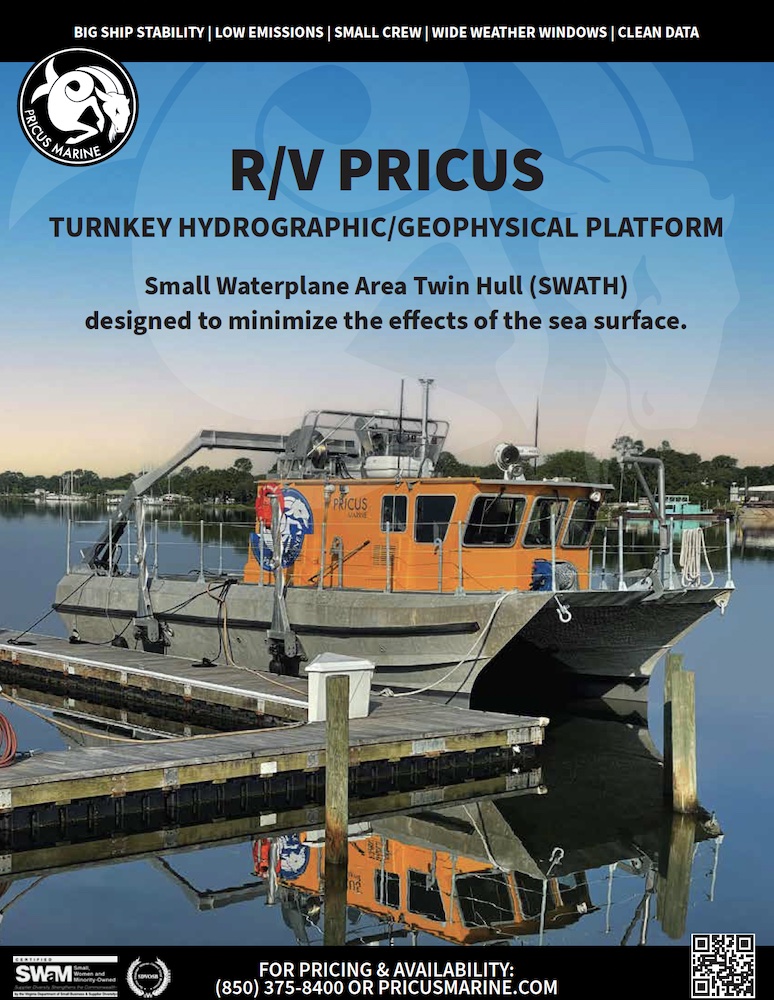
Our SWATH research vessels offer unparalleled open-ocean safety, stability, and versatility with a shallow 4.5’ draft.

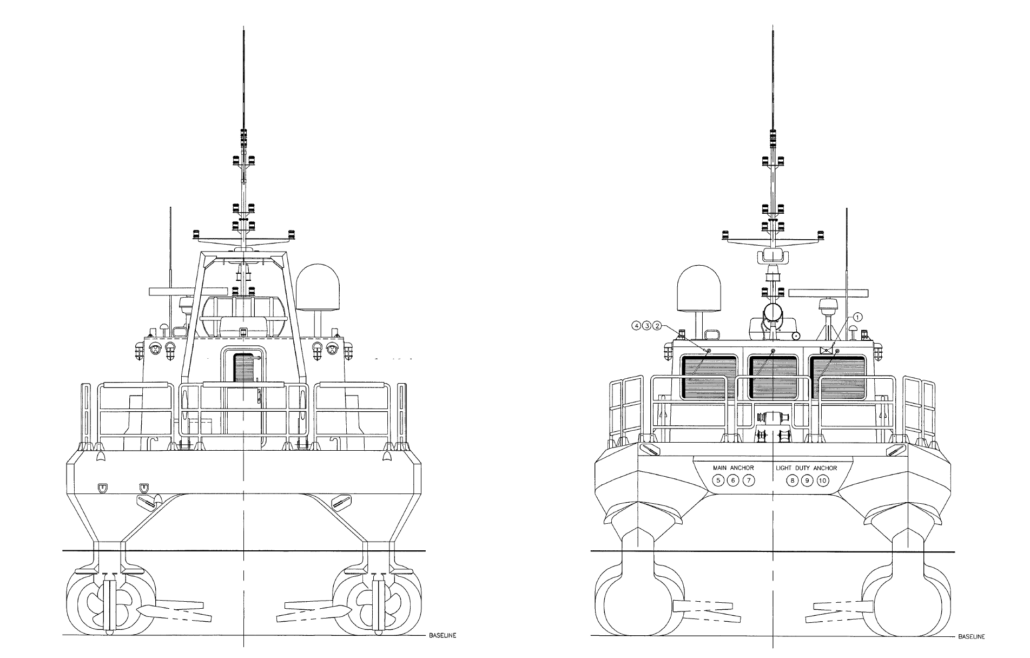
The SWATH hull form is an enabling technology that allows these relatively small shallow draft craft to have a complete open-ocean surveying capability that is unobtainable in a conventional vessel of a similar size and draft.

These vessels have proven themselves on multi-day deep ocean missions, performing search operations in sea state 5 conditions and gale force winds.

Fewer Weather Delays | Safer Operations | Cleaner Data

STABILITY

Her SWATH hull form is inherently stable regardless of vessel speed or swell direction & provides a platform optimized for slow-speed seakeeping.  She has four computer-controlled motion control planes to actively stabilize her to only two degrees of roll, even in 10-14 ft seas.


LESS SEA SICKNESS

In Sea State 4, R/V Pricus is designed for a Vertical Acceleration of only 0.04g’srms and Motion Sickness Index (MSI) of 1%rms.  Pricus’s Vertical Acceleration is well within the tolerable area of human acceleration tolerance boundaries (the “threshold of malaise” is approximately 0.1 to 0.2g’srms and “intolerable conditions” are 0.20 to 0.60g’srms, depending on wave frequency).

LESS CREW FATIGUE

Reduced fatigue results in greater attention to equipment operation, thereby enhancing the overall capability of the operator.  With her extremely low vertical acceleration, operators experience fewer Motion Induced Interruptions (MIIs) meaning less crew fatigue overall.

AVAILABILITY

Pricus was designed to continue operations through WMO Sea State 4 and survive Sea State 6.  Based on National Data Buoy Center records for 2019, the significant wave height in Rhode Island Sound remains at or below Sea State 4 more than 90% of the year.

SAFETY

Due to her superior seakeeping characteristics, Pricus offers greater crew safety from sea conditions due to fewer motion-induced accidents at sea.

BETTER MANEUVERABILITY

Her propellers and rudders are positioned at the aft end of each pontoon, placing them in the most outboard position possible.  This offers precise steering control and exceptional maneuverability resulting in a smaller Standard Deviation of Navigation Error (SDNE). A smaller SDNE results in a higher survey efficiency, an operational advantage to the surveyor.

Collecting Clean Data Saves Time and Money

The best post-processing is collecting clean data in the first place.  Minimal vessel motions, hydrodynamically optimized transducer mounts,  and first-class positioning give you a competitive  advantage.

IMPERVIOUS TO DIRECTION OF SEAS

SWATH seakeeping characteristics are far less susceptible to the direction of seas. With conventional vessels, the direction of the seas may force tracks to be laid out in an unfavorable geometry. With a SWATH vessel, the direction of the seas should be immaterial as long as sea states are within designed operating parameters of Sea State 4. This also helps contribute to less sea sickness.

SEAMLESS COVERAGE

The enhanced sonar performance facilitated by the SWATH permits seamless sonar coverage of an area due to the minimal roll, yaw, and pitch of the vessel.